
services
Waste to energy plants
1. Package Plants
Cominergy is a Pan-African industry leader in supplying package wastewater treatment systems, related component equipment, and replacement parts. Our Company offers the end user a pre-engineered and pre-fabricated method of biological wastewater treatment for domestic and some industrial wastewater applications.
Our selection of a packaged treatment plant offers the user a pre-engineered and pre-fabricated method of treating wastewater with an aerobic process. The final effluent can be released safely into the environment such as receiving streams, rivers, etc. Treated non-potable water is also being used as a new source of water to promote agricultural and aquaculture production, industrial uses, water sustainability, and reclamation uses such as irrigation, wash down, and / or artificial recharge.
Clarification
Chlorination / Disinfection
Extended Aeration – EA
Activated Sludge Process
Nitrification / Denitrification
Oil / Water Separation – OWS
Tertiary Treatment
Land Development / housing / subdivisions
Small and medium sized communities and cities
Mobile Home Parks
Remote mining, logging, energy projects and construction sites
Recreational areas such as parks, campgrounds, marinas
Manufacturing facilities, power plants, military bases
Schools and other educational campuses
Government compounds
Low Flow / High Strength and High Flow / Low Strength applications
Some of the advantages include:
Pre-engineered, prefabricated structures result in lower cost.
Unit is easily transported to the customer’s project site.
Design allows for quick turnaround time for delivery and installation.
Treatment System is simple to operate and requires low manpower.
Effective extended aeration principal
User friendly – low and easy maintenance
Regulatory compliant
Custom design / application specific systems
Long service life
MODULAR SYSTEMS
Pre-engineered modular components such as diffused air blowers, flow equalization tanks, aeration tanks, sludge holding tanks, wastewater clarifiers, and disinfection units allow for the package plants to be sized specifically for the customer’s application. They can be designed to handle a variety of influent flow rates and BOD loadings to meet discharge requirements.
Wastewater Flow Process
A decentralized wastewater treatment system, commonly referred to as a “packaged plant”, utilizes the biological extended aeration principle of operation, which is a variation of the activated sludge treatment process. This system functions by creating an environment with sufficient oxygen levels and agitation to allow for bio-oxidation of the wastes to suitable levels for discharge.
Wastewater Flow Process
A decentralized wastewater treatment system, commonly referred to as a “packaged plant”, utilizes the biological extended aeration principle of operation, which is a variation of the activated sludge treatment process. This system functions by creating an environment with sufficient oxygen levels and agitation to allow for bio-oxidation of the wastes to suitable levels for discharge.
Waste material in domestic wastewater is generally organic (biodegradable) which means that microorganisms can use this matter as their food source. A biological wastewater treatment system makes use of bacteria and other microorganisms to remove up to 95% of the organic matter in the wastewater.
Biological waste water treatment systems and processes were actually developed by observing nature. As waste entered the stream, the dissolved oxygen content in the water decreases and bacteria populations increased. As the waste moved downstream, the bacteria would eventually consume all of the organic material. Bacterial populations would then decrease, the dissolved oxygen in the stream would be replenished, and the whole process would be repeated at the next wastewater discharge point.

EFFICIENT MULTI-STEP WASTEWATER TREATMENT PROCESS
- The influent wastewater enters the wastewater treatment package plant by passing through a comminutor and/or bar screen for gross solids removal. This step provides for the mechanical reduction of solids prior to aeration.
- Once the wastewater has entered the aeration chamber, the untreated flow is mixed with an active biomass in a rolling action that takes place the length and width of the chamber in a slow forward progression. This rolling mixing action is the result of air originating from air diffusers located along one side of the bottom of the tank. This insures that adequate mixing is maintained in the tank. The chambers are filleted on each side along the bottom to assure and enhance the rolling motion of the water and to eliminate any “dead zones” in the tank. The oxygen transfer achieved with the diffused air passing through the wastewater coupled with the rolling action provides a sufficient oxygen supply allowing microorganisms to oxidize treatable wastes in to carbon dioxide, water, and stable sludge.
4. The treated water flows from the clarifier to a disinfection chamber for treatment via chlorination or ultra-violet (UV) disinfection prior to discharge to complete the treatment process. Tertiary filters may also be used where a higher quality of effluent is required.
3. After aeration, the wastewater flows to the clarifier that typically has a hopper bottom configuration. The wastewater clarifiers are sized to provide the required retention time based on an average twenty-four hour design flow. During the settling period, solids settle on the bottom of the clarifier. Airlift pumps with adjustable pumping capabilities are used to return these solids, as activated sludge, to the aeration chamber to maintain the maximum efficiency of the biological process. When necessary, excess sludge is wasted to an aerated sludge digestion tank for additional treatment and reduction. A skimmer airlift pump is used to return floatable solids and scum to the aeration chamber for further processing.
2. Wastewater Treatment Plants
When considering what wastewater treatment plant process will best serve your needs, there are several options Cominergy can offer. At Cominergy, we will analyse your wastewater properties, load capacity and design requirements to provide a solution that is both efficient and effective.
CLARIFICATION (CIRCULAR MECHANICAL)
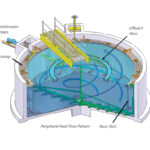
Flow enters through the centre stilling well and is forced downward, ensuring a proper settling time before it rises and exits through the wall-mounted weir troughs. The skimmer covers the surface of the clarifier between the centre stilling well and the scum baffle.
Flow enters at the periphery, where it is evenly distributed and spiralled downward around the annulus by means of the specifally designed baffle skirt, providing for maximum settling toward the sludge pickup. Flow exits through the center-supported weir troughs.
CLARIFICATION (PARALLEL PLATE)
The collection surface of the inclined parallel plate packs allows the solids to easily slide downward to the hopper bottom solids collection chamber below. The collected solids will require removal by maintenance personnel. The clarified effluent will overflow an adjustable weir into an effluent chamber. The clarified effluent will then exit via gravity to discharge.
CHLORINATION/DISINFECTION
Disinfection is the process of destroying pathogenic micro-organisms by physical means. There are a number of chemicals and processes that will disinfect wastewater. Disinfection is usually the final stage in the wastewater treatment process in order to limit the effects of organic material, suspended solids, and other contaminants.
The primary methods of disinfection in the wastewater treatment process are Ultraviolet Irradiation or Disinfection (UV) and chlorination. Although both methods are acceptable and effective, chlorination is typically the most economical method of disinfection.
EXTENDED AERATION
Extended Aeration is a variation of the activated sludge process with no primary settling. The Extended Aeration process has a 24 hour aerobic retention time which results in the generation of less excess sludge.
Extended Aeration is a biological treatment process, which is able to produce a high quality of effluent. This process is widely used and recommended for installations remote of city sewers. Users span from small and medium sized cities, land development/housing subdivisions, mobile home parks, remote mining, logging, and construction sites, recreational areas, parks and marinas, military bases and educational facilities, and low flow/high strength as well as high flow/low strength applications.
Extended Aeration is the most popular biological treatment process in package style wastewater treatment which produces a high quality effluent with ease of installation, operation, low maintenance, and operational costs.
ACTIVATED SLUDGE
Wastewater is collected into an aeration tank, where oxygen is introduced to the sewage. This mix (sometimes called a mixed liquor) utilizes the bacteria and protozoa that feed on organic matter in the wastewater. After the period of agitation has ended, the sludge will settle to the bottom where it is introduced to sewage in the wastewater into a primary clarifier while the wastewater moves on for further treatment.
NITRIFICATION/DENITRIFICATION
Nitrification of wastewater relies on the bio-chemical reaction of the nitrogen in ammonia to nitrite, and eventually nitrate. The organic ammonia present in wastewater can come from multiple sources such as animal proteins, urea, and amino acids. Bacteria then breaks down the ammonia into nitrite.
Denitrification is required to remove the toxic nitrate from the wastewater before it can be purified even further. Removing the nitrate requires a conversion to nitrogen gas. This process can only be performed under anaerobic conditions; bacteria present in a near zero oxygen environment.
OIL/WATER SEPARATION
The operation of the coalescence type separator is based on the use of surface areas that reduce the distance an oil droplet must travel before it reaches a collection surface. The coalescence plates are constructed of materials that are hydrophobic (water repelling) and oleophilic (oil attracting). When the oil droplet comes in contact with the plate, it reaches a zone of zero velocity and adheres to the surface. The coalescence surfaces multiply the effectiveness of the natural action of oil and water to separate.
As the media plates become coated with continuously agglomerating oil, the oil begins to form droplets, which coalesce or migrate upward. This creates a condition that accelerates the vertical movement of the oil. The oil coating the media surface accumulates at the top edge of the media where it detaches as a droplet and floats to the surface of the separation chamber. Once it breaks away from the media, the oil then resides on the surface of the water. There are now two zones of liquid in the separator – oil and water. The oil is then collected for removal as the clear water is discharged through an outlet. Finally, sludge is collected in the media pack and settles in a separate compartment.
TERTIARY TREATMENT
The standard tertiary filter system provides filter cell flow division, filtration, air scouring, backwashing, and backwash return of the wastewater.
The filtrate percolates through each of the multi-media filter cells and then into the area below the filter nozzle plates. From there, the filtered wastewater flows through the backwash piping, the backwash pumps, and into the clearwell tank. The filtered water in the clearwell will then overflow an effluent weir trough to disinfection and exits the tertiary filter system to complete the treatment process.
When the surface of the filter cells become clogged or covered with solids, the wastewater level begins to rise.
The rising wastewater level activates the air scouring and backwash cycles. The backwash cycle will use filtrate from the clearwell to backwash and dislodge the solids entrapped in the media. The media will be automatically air scoured and backwashed as air and clean filtrate water is pumped through the filter media from the bottom up, dislodging the retained solids. The rising backwash water overflows into the surge (backwash return) chamber. The surge chamber collects the backwash water and, over a several hour period, will return it back to the head of the wastewater treatment system.
